 by Admin
Is The Basic Board Syllabus In Chemistry Sufficient To Crack JEE For An IIT Seat?
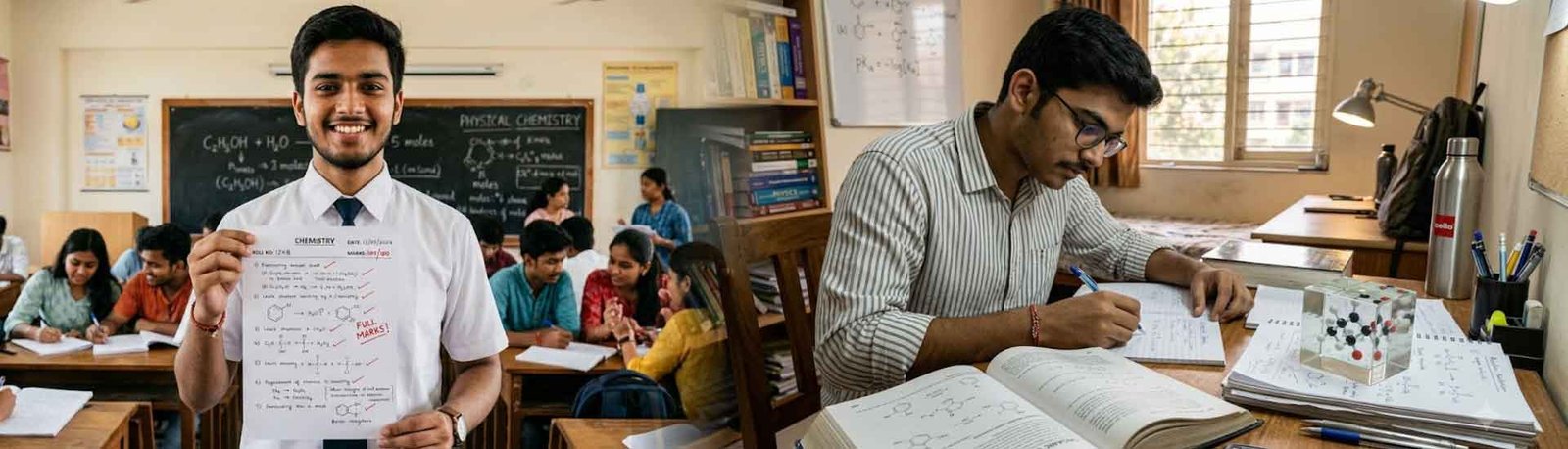
If you are preparing for the Joint Entrance Examination (JEE) with dreams of securing a seat at an Indian Institute of Technology (IIT), you have likely asked yourself: “If I thoroughly master my Class 11 and Class 12 Board syllabus, is that enough to crack JEE Chemistry?”
The short answer is no, but it is essential for the foundation.
While a solid grasp of the Board syllabus particularly NCERT or equivalent Board textbooks is mandatory, it is rarely sufficient on its own to score high enough in JEE Advanced for an IIT selection. This is why many students seek guidance from an experienced chemistry teacher in Kolkata who can help them prepare strategically.
Understanding where the Board curriculum ends and where JEE requirements begin is the key to bridging the gap.
Board Exams vs. JEE Chemistry: What Changes?
The fundamental scientific principles do not change between your Board exams and JEE. What changes drastically is depth, application, and problem structure.
|
Board Chemistry |
JEE Chemistry |
|
Focuses on "What" & "Define" |
Focuses on "Why" & "What if" |
|
Direct formula substitution |
Multi-concept numericals |
|
Step-wise theoretical answers |
Speed, accuracy & logic |
|
Predictable question patterns |
Novel & combined problems |
Subject-Wise Breakdown: Board Level vs. IIT JEE Level
To see where the differences lie, let’s look at the three branches of Chemistry:
1. Physical Chemistry
Board Level: Tests direct formula application, standard definitions, and basic numerical (e.g., calculating molar mass or finding the rate law using given data).
JEE Level: Requires multi-concept integration. A single question in JEE Advanced might combine Chemical Equilibrium, Thermodynamics, and Electrochemistry. You must understand the derivation of formulas and know their precise boundary conditions rather than just plugging in numbers. Students attending chemistry tuition in Kolkata often benefit from structured problem-solving sessions that improve both speed and accuracy.
2. Organic Chemistry
Board Level: Covers standard functional groups, named reactions (like Cannizzaro or Aldol condensation), and basic distinction tests.
JEE Level: Focuses heavily on Reaction Mechanisms, Stereochemistry, and Multi-step Synthesis. JEE Advanced rarely asks direct named reactions; instead, it presents an unusual starting reactant under modified reaction conditions to test whether you understand electron movement (reaction intermediates like carbocation rearrangements).A skilled chemistry sir focuses on building conceptual clarity so that students can solve new types of questions with confidence rather than depending on memorized reactions.
3. Inorganic
Board Level (NCERT): Covers trends in properties, oxidation states, and preparation methods.
JEE Level: Interestingly, Inorganic Chemistry has the highest overlap with the Board/NCERT syllabus. However, JEE tests specific exceptions, coordination compound isomerism, crystal field theory depth, and qualitative salt analysis that Board exams often skim over.
The Core Differences in Thinking
The Board Mindset: Memorize the definition, write the exact steps, and get full marks.
The JEE Mindset: Understand the core mechanism, eliminate incorrect choices, and adapt when presented with a completely new scenario.
1. Question Types: Board exams feature descriptive and short-answer questions. JEE Advanced features multiple-correct options, numerical value questions, paragraph-based problems, and matrix-matching.
2. Negative Marking: In Board exams, partial steps yield partial marks. In JEE, a minor calculation error or misreading an option leads to negative marks.
3. Time Pressure: Board exams give ample time to write long answers. JEE demands solving complex numericals or mechanism problems within 2 to 3 minutes.
How to Bridge the Gap: From Board Basics to IIT Advances
If you already have a strong grasp of your Board syllabus, you are in a great position. Here is how you can level up your Chemistry preparation:
1. Master the "Why" Behind Reactions: Don't just memorize organic reactions. Study reaction mechanisms (*electrophilic addition, nucleophilic substitution, inductive/resonance effects*) so you can predict products for novel compounds.
2. Solve Advanced Numericals Daily: For Physical Chemistry, move beyond textbook exercises. Solve numerical problems that involve quadratic equations, logarithms, and multi-chapter concepts.
3. Analyze NCERT Line-by-Line for Inorganic: Read every footnote, table, and anomaly in NCERT Chemistry. Many JEE Main and Advanced Inorganic questions are directly sourced from overlooked lines in NCERT text.
4. Practice Previous Years' Questions (PYQs): Solve at least 10–15 years of JEE Main and JEE Advanced PYQs to familiarize yourself with the question patterns and difficulty level.
5. Take Timed Mock Tests: Speed and accuracy under pressure are as important as subject knowledge. Regular mock testing builds exam stamina.
Guidance from the best chemistry institute in Kolkata can provide systematic preparation, regular assessments, and expert mentoring, making it easier to stay on track throughout the JEE journey.
Summary
The basic Board syllabus builds the skeleton of your Chemistry knowledge, but JEE demands the muscle and agility to apply that knowledge. Treat your Board syllabus as Step 1 of your journey—once your concepts are crystal clear, build upon them with higher-level problem solving, mechanism analysis, and consistent mock practice to claim your seat at an IIT.