 by admin
Bohr's Atomic Revolution - Quantized Orbits and Stability
Let's Start Learning:
The significant flaw in Rutherford's nuclear model of the atom—its inability to explain atomic stability—necessitated a new approach. Building upon Rutherford's foundational discovery of the nucleus, Danish physicist Neils Bohr (1885-1962) proposed a revolutionary model of the atom in 1913 that successfully addressed the stability issue. Bohr's work earned him the Nobel Prize in Physics in 1922 for his contributions to the understanding of atomic structure.
Bohr's model introduced groundbreaking concepts that departed from classical physics, laying some of the early foundations for quantum mechanics. His model was based on the following key postulates:
- Discrete Orbits (Energy Levels): Bohr proposed that only certain special orbits, known as discrete orbits of electrons, are allowed inside the atom. This means that electrons can only exist in specific, well-defined circular paths or shells around the nucleus, not in any arbitrary orbit. These orbits or shells are referred to as energy levels.
- Non-Radiating Electrons: Crucially, Bohr postulated that while revolving in these discrete orbits, electrons do not radiate energy. This directly contradicted the predictions of classical electromagnetic theory, which stated that an accelerating charged particle should continuously emit energy. By preventing energy radiation in these specific orbits, Bohr's model elegantly resolved the problem of atomic instability; electrons would not spiral into the nucleus.
Energy Levels and Shells:
Bohr further elaborated on these discrete orbits, calling them energy levels or shells. These shells are represented by letters, namely K, L, M, N, and so on, or by numbers, where n = 1, 2, 3, 4, and so forth, with n=1 corresponding to the K-shell, n=2 to the L-shell, and so on. The K-shell (n=1) is the orbit closest to the nucleus, followed by the L-shell (n=2), and so on.
Electron Distribution Rules (Bohr-Bury Scheme):
Bohr, along with E. Bury, also suggested rules for how electrons are distributed into these different orbits or shells:
- Maximum Electrons per Shell (2n² Formula): The maximum number of electrons that can be present in a given shell is determined by the formula 2n2, where 'n' is the orbit number or energy level index.
- K-shell (n=1): 2×12=2 electrons
- L-shell (n=2): 2×22=8 electrons
- M-shell (n=3): 2×32=18 electrons
- N-shell (n=4): 2×42=32 electrons, and so on.
- Maximum in Outermost Shell (Octet Rule): The maximum number of electrons that can be accommodated in the outermost orbit of an atom is 8. This is a crucial rule for understanding chemical reactivity.
- Step-wise Filling: Electrons are not accommodated in a given shell unless the inner shells are completely filled. This means shells are filled in a step-wise manner, from the innermost (K-shell) outwards.
Bohr's model, with its concept of discrete energy levels and non-radiating electrons, successfully explained the stability of atoms and laid the foundation for understanding atomic spectra and chemical bonding. It was a monumental leap forward in atomic theory, bridging the gap between classical physics and the emerging field of quantum mechanics.
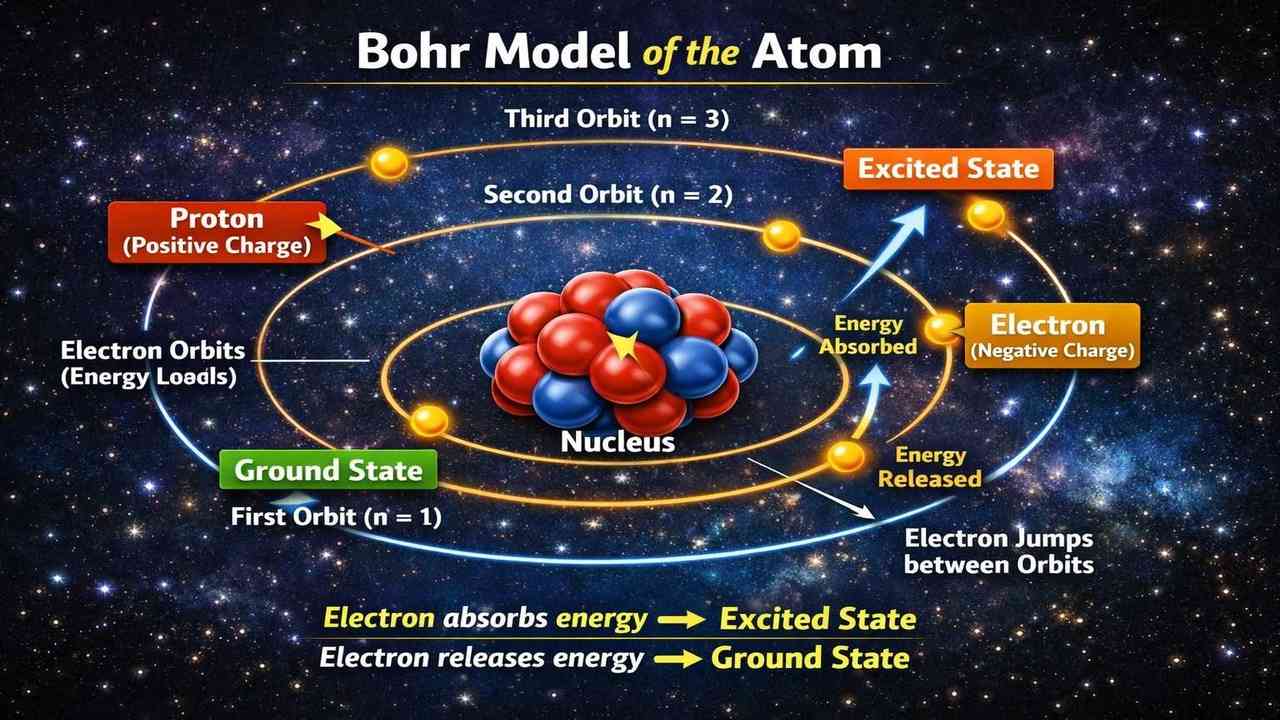
Question for You: Draw a sketch of Bohr's model of an atom with three shells (K, L, M) and label the nucleus and each shell.